Maybe when you think of Oman, the first thing that comes to mind are miles of empty sand dunes stretching into the horizon – while this may be true, Oman can offer so much more.
Although not as developed for tourism as its neighbours, this allows Oman to retain its sense of identity, heritage and history, while still offering quality hotels located between majestic mountains and pristine white beaches lapped by the azure blue seas.
Oman can offer something for everyone from the thrill seekers, to the sun worshippers, for those wishing to explore its rich and cultural heritage, to shoppers eager to grab a bargain or two within its traditional colourful souks, where the aroma of Frankincense fills the air.
If getting back to nature is your thing then camp out under the stars in a Arabian tent, where sand dunes tower above you, and the night stars are like you have never seen before.
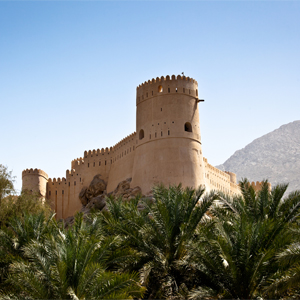
When in Oman, there is no time to lose, with the many activities on offer. from its history to its amazing wildlife, see turtles come ashore to their breeding grounds or explore desert forts hidden amongst palm trees next to an oasis deep in the beautiful isolation of the desert.
Oman PACKAGES
Grand Tour of Oman
15 Days
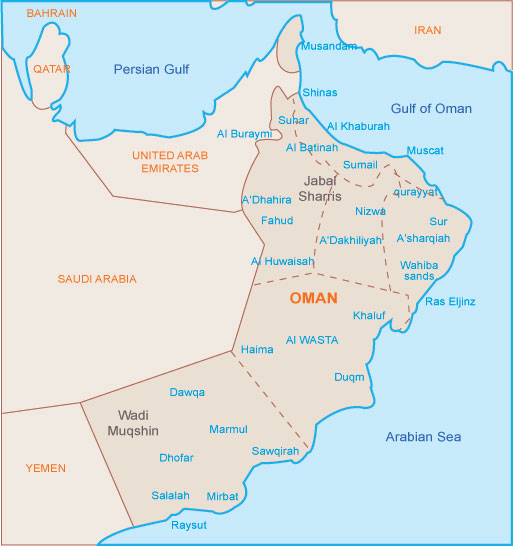
Muscat - Salalah - Nizwa - Wahiba Sands - Ras El Jinz
Starting From : £3268
Family Holiday to Oman
8 Days
Muscat - Wahiba Sands - Ras El Jinz
Starting From : £1807
Taste of Arabia
9 Days
Muscat - Nizwa - Wahiba Sands - Ras El Jinz
Starting From : £2232
Oman Travel Tips
Language The official language of Oman is Arabic, but English is widely spoken. Hotel staff often also speaks German and French.
Visas You may apply for a single-entry visa on arrival at Muscat International Airport. British citizens don't need to get a visa before travelling to Oman. You can get a visa on arrival at any land, sea or air entry port in the country. For Stays of 10 days only the entry visa is charged at USD 14.00 per person & for above 10 day to 30 days is charged at USD 53.00 per person.
Health Precautions From a medical standpoint, Oman is a safe and healthy country to visit. There is an extensive network of healthcare facilities throughout the country excluding some remote areas in the desert and mountains. Should you require medical assistance there are clinics and pharmacies in many cities and towns.
In all likelihood, the arid tropical climate of Oman will be quite different from the one you came from.
No vaccinations are required for entry to Oman. Visitors should ensure they are up to date on all routine vaccinations. Health and medical services in the country, particularly Muscat, are of a high standard, but are expensive for foreigners (Oman nationals receive free treatment), so health insurance is recommended. Food and water in Muscat is considered safe, but bottled water and precautions with unpasteurized milk are advised outside of the city.
Currency The unit of currency is Omani Rial (RO 1 = GBP 1.56) which is divided into 1000 Baiza. Notes are available in denominations of RO 50, 20, 10, 5, 1, 1/2 Rial, 250, 200 and 100 Baiza. Coins are also in use for units under one (1) Rial.
Tipping The Sultanate of Oman is a destination where your dreams of 1001 nights will come true. Oman is a great destination for every outdoor fan. The Omani people are very friendly and open. You should wear appropriate clothing. For women this means to cover their knees, shoulders and cleavage and when visiting mosques also to cover their hair and ankles. Men should actually consider the same, except covering the hair.
A tip of 10 percent is considered the norm in restaurants, although a service charge is usually added to bills; however a 'little extra' is appreciated, as the service charge usually never makes it to the attendant. A general rule would be 5% additional to service charge, or between 10-15 percent where service has not been added. It is not usual to tip custodians of museums, forts and suchlike, who are usually Omani citizens rather than immigrant workers. Fares for taxis should be agreed before you get into the car - always haggle, it's expected.
Banking Hours The usual bank opening times in Oman are 8:00 am to 12:00 pm and from 02:30 pm to 06:00 pm Saturday to Wednesday, and 08:00 am to 11:30 am on Thursdays. During Ramadan, it is usual for banks to open one hour later, at 09:00 am.
Visa and MasterCard are widely issued and accepted, with American Express and Diners Club accepted to a lesser extent. If you withdraw cash from ATMs using a credit card, expect to pay a fee. Currency exchanges and banking facilities are available at major airports and, as well as exchange services in hotels, there are bureau de change in most towns and cities. Do shop around for the best exchange rates.
Climate Oman has a light monsoon climate with the weather being mainly hot and dry. It is particularly hot in the barriers, where summer temperatures can reach up to 54°C. Humidity can be high on the coast in summer. Milder temperatures and a temperate climate can be found in the southern part of the country, with heavy monsoon rains between June and September. The rest of the country experiences low precipitation.
What to Wear: Light cotton clothes are advised throughout the year; however, something warmer should be packed for the cooler evenings and winter months. Comfortable walking shoes are recommended for excursions to mountainous regions. Women should not wear short, revealing and tight clothing, and their shoulders and knees should be covered at all times. Beach wear is appropriate for closed beach clubs and hotel beaches only (sunbathing 'topless' is unwelcome).
What you need to bring with you
Long-sleeved shirt and long pants to wear while outside whenever possible, to prevent illnesses carried by insects.
Insect repellent containing DEET (diethylmethyltoluamide), in 30%-35% strength for adults and 6%-10% for children, as well as a bed net impregnated with the insecticide permethrin. (Bed nets can be purchased in camping or military supply stores.)
Over-the-counter antidiarrheal medicine to take if you have diarrhea.
Iodine tablets and portable water filters to purify water if bottled water is not available.
Sunblock, sunglasses, hat.
Prescription medications: make sure you have enough to last during your trip, as well as a copy of the prescription(s).
Copy of your passport, credit card numbers, and toll-free numbers to call in case of credit card loss. Give another copy and your itinerary to someone who can easily be reached, so they can be sent to you if necessary.
Before you go, call your bank and credit card companies to give them a heads up, as in these days of high security, they may block your card if they aren't forewarned about your foreign spending.
Pages of guidebooks: Rip out those that apply to your destination. Don' take the whole heavy book.
Medical Services There are numerous pharmacies across the country, all of which should be able to produce at least one English-speaking pharmacist. All the major cities have at least one 24-hour pharmacy, your hotel should be able to provide details of the nearest outlet. Note that some medicines which are available over the counter, while it also helps to know the generic name of any drug you might require, in case the particular brand you'e used to purchasing at home isn't available. There are good hospitals in major towns and clinics elsewhere. Pharmacies are mainly open 09:00 am-01:00 pm and 04:00 - 09:00 pm, and some open 24 hours. All the following hospitals have English-speaking staff.
Getting around There's very little public transport in Oman. Buses will, at a pinch, get you between the main towns and cities, but to really see anything of the country you'll need your own transport, either by signing up for a tour, hiring a guide-driver, or getting behind the wheel yourself.
Oman has a comprehensive system of cheap but slow long-distance shared taxis (painted orange and white) and microbuses. Oman's shared taxis and microbuses do not wait until they are full to leave. Instead, drivers pick up and drop off extra passengers along the way.
To visit certain places of interest, you'll often have to take an 'engaged' taxi (ie private, not shared) - generally four times the price of a shared taxi as you have to pay for all the seats. Bargain hard before you get in and try to avoid hailing a taxi from a hotel.
Electricity Electrical current is 220/240 volts; 50Hz. Plugs with rectangular, three-pin flat blades are used.
Shopping Many of the items can be found in souks all over the country, although for the finest array of Omani goods under one roof nothing beats a visit to the legendary Muttrah Souk in Muscat. The souks at Nizwa and Salalah also offer an excellent selection of merchandise - Nizwa is particularly celebrated for its handicrafts, while Salalah is perhaps the best place in the country to pick up samples of the greatly prized Dhofari frankincense. Prices are rarely fixed, however, and bargaining is very much the order of the day.
For a more contemporary, but in many ways equally rewarding, shopping experience, head to one of the many Lulu Hypermarkets which dot the country (the one between Muttrah and Ruwi in Muscat is convenient, and particularly good). A browse through the aisles here uncovers a fascinating array of local, Arabian and Asian produce, usually at bargain prices - anything from tubs of dates, jars of Yemeni honey, big packets of cut-price spices and great piles of outlandish vegetables through to traditional Indian tiffin-boxes and bars of sandalwood soap.